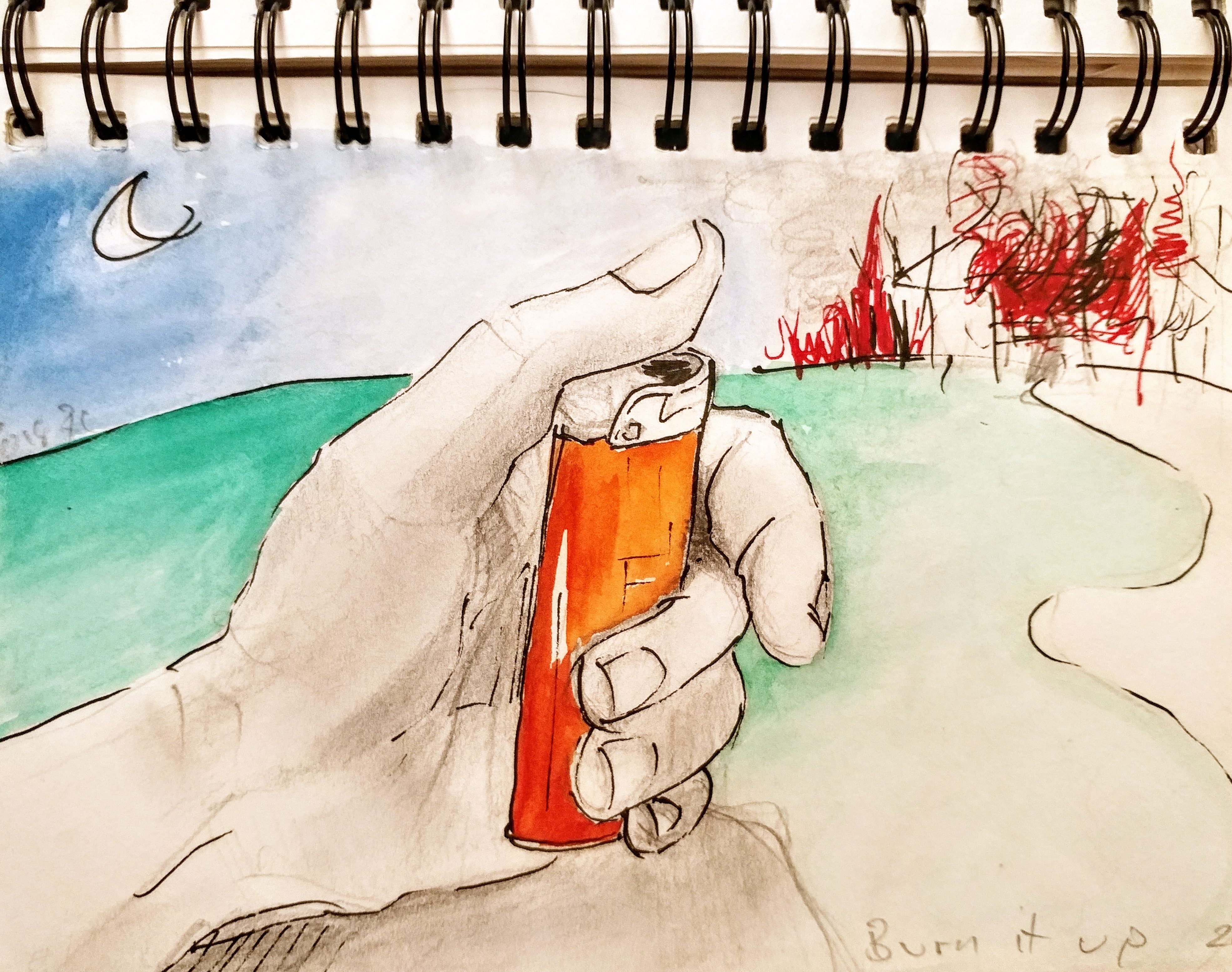
the artist’s Task
the Artist’s Task
“The artist’s task is to save the soul of mankind; and anything less is a dithering while Rome burns. If artists cannot find the way,then the way cannot be found.” Terrence McKenna
To whom shall I hire myself out?
What beast must I adore?
What holy image is attacked?
What hearts must I break?
What lie must I maintain?
In what blood tread?
– Rimbaud
Bones
Silent and still
In caves and caverns long-forgotten, tucked deep under steel and concrete,
lay my bones, my cold dry ancestral bones,
once witness to undocumented histories.
But when bones come up as they do, an infinity of souls sigh –
they never stop whispering, offering their unwanted secrets.
Here I am,
trapped somewhere in between,
where symbols meet substance and ideas seed potential.
If I squint I can see them now
the tellers of the obvious.
My imitation eyes have limitations, until eternal night comes,
bringing colours unimagined,
weaving stories never heard that change the atmosphere.
It’s cold in there, but the apprehension’s lovely,
watching, waiting,
catching a glimpse of what precedes the manifested,
of souls that take shape in the trees, the ancient ones.
I’m a passing cloud
that exists in dissipation with the wind.
I remember being laid to rest in the befores and afters,
and the tales that never stop falling from dumb lips,
begging to be heard, because the dead love to talk.
I’m barely real now.
I’m a glitch, a spark, a twitch, a perfectly faulty entity, the gods know me well,
omnipresent as dust, they write secrets in my blood,
it’s caked on the tips of their fingers, it fills small spaces.
And here, look, here’s my bones,
as still and silent as the end of chaos.
……………………………………………….
2014
Politics, media, & an unfettered free market economy
We don’t mix God with politics
“Bullshit is all the reasons we give for living. If we can’t think up reasons of our own, we always have the God bullshit.” (Chayefsky 1976)
While architecture, music, fine arts and literature owe much to religious inspiration and patronage, average interpretations of religion are at best fluffy, delusional or mediocre, and at worst elitist, despotic and depraved.
Politics is by nature an extension of religion, but without God. We don’t do God in Australian politics though the similarity between politics and religion is undeniable, particularly when you look at neoliberal-driven politics. It has its own catechisms in accordance with an exalted code of conduct, has universal ambitions, is buoyed by a legal system that tramples the meek and vulnerable, and directs its benefits almost exclusively to a power elite. It even has a prophet in Friedrich Von Hayek, and its church is the The Mont Pelerin Society. This demiurge passes control of its pilfered resources to an undeserving progeny through the act of nepotism. Australian politics is in a death-grip with Mammon, lord of economics, king of all wars and hence the most prolific serial killer of all time. The total deaths in recorded history now number the hundreds of millions.
Social movements often originate from well-intentioned philosophies but they have a knack of morphing into messy complex counterfeits. Politics walks a fine line between truth and bullshit.
Mass media follows the corporate imperative
“We no longer live in a world of nations and ideologies, Mr. Beale. The world is a college of corporations, inexorably determined by the immutable bylaws of business. The world is a business, Mr. Beale.” Chayefsky 1976
There is significant mainstream confusion, deliberate or otherwise, around definitions of democracy in capitalist societies. Democratic intellectuals such as Noam Chomsky are relentlessly misrepresented in their defence of social democratic ideology and social policy, despite the effort to shine some light into the darkness, which isn’t ahead of us…it’s here, now. Some Western journalists portray social democracy as a form of either socialism or communism, adding to the confusion within Western ideological and political debates. If political ideologies are open to interpretation then they are the godless extensions of religious dogma, and in a capitalist free-market state the definition of a political ideology is limited to the parameters of the dominant economic forces that influence government policy making.
These dominant forces direct corporate mass media and frame mainstream discussion, setting the agenda, influencing and manipulating public opinion on the benefits of the state versus the free market, while pushing far-right sociopolitical and economic agendas. Mass media always follows the corporate imperative, filtered to assure conformity to the interests and needs of an elite private sector. Media networks that don’t tow the line are pushed aside (defunded) in favour of those that support the corporate social purpose. Transnational media operates within the limits of a market-driven satellite news oligopoly. The spectacle of violence and suffering sells, hence it’s prioritised and produced to suit the demands and tastes of a Western audience, while serving shadowy private interests.
The Twin towers & disaster capitalism
“I don’t have to tell you things are bad. Everybody knows things are bad” Chayefsky 1976
The events of September 11 2001 was the start of a new era. Since then political violence has touched every Western nation to some degree. Aired and viewed in real time on screens and portable devices, the 9/11 spectacle was mediated, analysed and officially concluded, despite obfuscated, unanswered questions from intelligent observers who raised concerns about the ‘background noise’ of 9/11 (Architects & Engineers for 9/11 Truth 2016). We’re collectively traumatised by an ongoing series of shocks, imparted with precision by transnational media. Between shocks, we return to our daily lives, our families, our careers, our pursuits as if nothing’s changed. We ask few questions, receive fewer answers, yet obediently follow the edicts of governments that seem hijacked by devolving neoliberal ideologies.
It’s a fact that the neoliberal agenda seeks nothing less than the transfer of all public goods and services to the private sector. No one can argue that point. This undermines the significant social democratic achievements of regulated capitalist societies like Australia. The post 9/11 period accelerated the global spread of neoliberal principles, using Naomi Klein’s term disaster capitalism with resistance, viewed as an obstruction to progress. Symbolically our power (electricity) was privatised, as we bought into neoliberal free-market philosophies, unconsciously, complacently entrusting our health services, our educational institutions and our social security into the private hands of a corporate sector that packages its booty with slick advertising campaigns and media propaganda. Western governments will continue to play the impending doom card as a political ace. It’s a transparent system, yet the masses dutifully adopt it with a kind of robotic conformity. We wear this corporatocracy like a snug suit because we can’t see the details, the small print.
Le cirque de 9/11
“You’re never going to get any truth from us. We’ll tell you anything you want to hear; we lie like hell” Chayefsky 1976
Hiram Johnson said in 1917 that the first casualty in war is truth. Rumours of war trigger social, hence economic panic and a proliferation of propaganda, at a time when people need accurate, balanced information, but is this what dominant governments and media deliver? The term ‘War on Drugs‘ rolled out the red carpet for the ‘War on Terror‘, which then graduated to the ‘Global War on Terror‘ (GWOT). In what amounts to a class war, with the global rich lording it over the global poor, one has to take pause at the power of these terminologies and of the role mass media plays as vehicle for western propaganda. This kind of rhetoric was a bit of a joke when it first appeared; nevertheless it was embedded in mainstream political vernacular, like an infection.
After the events of September 11 the western world was rocked by events rarely experienced by western nations. We witnessed epic dramas unfold live via satellite. We may never know the entire truth of 9/11, however western governments have ridden the wave of an emerging fear culture ever since. I.F. Stone once explained to a group of young journalists that when covering politics, the first thing to consider is that all governments lie. I remember the instinctive distrust during 9/11 media coverage, it was my first thought, I knew it would be used as motivation for an invasion of Iraq, I knew it immediately. It was inevitable and we all knew it. Media networks covered 9/11 like a sports event, repeating segments over and over to an international audience that was dumb struck, horrified, but too scared to switch off their screens. It was reality TV at its finest and marked the global shift from risk society to threat society. Rather than a breaking news event, it was a slickly produced historical narrative, complete with denunciative moral agency and promises of revenge. It had the whole world’s attention and it worked. We had front row seats at the circus, with media ringmasters directing our gaze to wherever it was required.
The Bin Laden/ Hussein adjustment & Weapons of Mass Deception
“You’re beginning to believe the illusions we’re spinning here.” Chayefsky 1976
Anyone who paid attention would have noticed the sudden rhetorical switch from Osama Bin Laden to Saddam Hussein in the immediate post 9/11 period. I remember that switcheroo well. I brought it up often in conversations but no one seemed to fully grasp the implications. Sure, I understand, people were in shock, and have been exposed to successive shocks ever since, so this glaring inconsistency was lost in the din, now long forgotten. Osama Bin Laden was conveniently dropped from the mainstream media landscape and Hussein was spliced in as his understudy and no one talked about it much, if at all. Bin Laden and Hussein were eventually snuffed, I’m sure the footage is still available out there, but the ‘Axis of Evil’ agenda shifted public attention from one enemy to another, as documented in global news trends covering a pre and post 9/11 world. As the US and her allies prepared the public for war, leaders simply manoeuvred their rhetoric through the media.
I wanted to tune out and take solace in the thought that nothing could ever sneak up on me again. I wanted to face reality with resignation and move on, however, I looked back and turned to stone. I still joined the march against the invasion of Iraq. Howard ignored us, enamoured as he was of George W. who juiced him up for the upcoming Free Trade Agreement. Murdoch’s journalists dutifully underplayed the protest numbers, but I was there – a lot of us were. The justification for war was sealed a long time before we reached the streets and I think we knew it.
There was no self-critical reflection by journalists, when it finally emerged that there were no Weapons of Mass Destruction in Iraq. The media became Weapons of Mass Deception. Hussein was conveniently hung and that was that.
Symbolic annihilation of the non-western ‘other’
“There are no nations. There are no peoples. There are no Russians. There are no Arabs. There are no third worlds. There is no West. There is only one holistic system of systems, one vast interwoven, interacting, multivariate, multinational dominion of dollars” Chayefsky 1976
In a socio-political sense, the non-Western other is only real while being discussed. The moment a designated ‘other’ is dropped from media discourse they cease to exist. It’s the forward thrust of political narcissism and a convenient distraction from the realities of war, which has stalked the Middle Eastern oil fields like the many-faced god and his faceless assassins. Western powers can invade the villainous Orient without contrition and with impunity under the banner of democracy and they beam these heroic efforts live via satellite through the amphitheatre of western media. We can access the horror through the Internet on multiple devices 24/7 as we rely on easy access to news media to assure us the threat is contained. The heroes and defenders of western democracy have always been our American heroes, who protect us from the perils of the non-western other. We can go to sleep safely knowing that all is well as long as our protector is out there, stationed in the vast Australian desert, carefully tending its garden of missiles.
The people, distracted, will always be divided
“I want you to go to the window, open it, stick your head out and yell: “I’m as mad as hell, and I’m not going to take this anymore.” Chayefsky 1976
Social media is both the opportunity to unite and a labyrinth of distraction. Castells bubbled with optimism on the potential of social media networks for social change; for shaping a brave new 21st century. As a public space we’re still awestruck by the grandeur of cyberspace with its transnational media and social networks. However from where I’m standing, favour increasingly leans toward the corporate interests of the companies that own them; companies that profile each user as a consumer and political punter. Facebook and Google have direct access to vast amounts of data, akin to having a crystal ball that can predict the future. Predictive analytics reveal collective trends across social, political and economic spectrums. Anyone who has the money and power to access and mine the data can prepare well in advance to stem the flow of an inconvenient social movement. They can divert attention, manipulate opinion and cut it off at the pass. It remains to be seen what kind of social change the World Wide Web will enable before I stop feeling like a fat juicy fly.
Australia has a complacent, manageable population with a vulnerable indigenous community. Most of us are immigrants or descendants of immigrants, with either colonial or post-war histories, and the majority of us are disinterested in politics beyond the few weeks of pre election madness that lead to an election, and our personal investment in the promises that come with this cyclical ritual. However we have a compulsory voting system with 78% enrolled (& 93 % of those voted in the 2013 election; IDEA 2016). The rest of the time we disengage from the political process and it shows. The rise of armchair activism aka ‘Clicktivism’ is one telltale sign of a dying democracy. More people claim to know that the emperor is stark naked yet only a fraction turn up at public protests – less if it’s raining. One could be forgiven for believing we’ve fallen into the clutches of a sociopathic, corporate ruling class. In Australia, Democracy can still parade the streets but only after applying for permission to protest. The naked emperor has been openly pirouetting for quite a while.
Bearing witness
“Indifferent to suffering; insensitive to joy. All of life is reduced to the common rubble of banality. War, murder, death are all the same to you as bottles of beer” Chayefsky 1976
My friend came to Australia from Bosnia as a refugee. He works hard to pay his mortgage and run a thriving business. He came with nothing from a war that left him with a multitude of questions. Why did UN peacekeepers disarm the Bosnians, put them all in one place and then leave them to be massacred? World governments knew it was happening. There were clear verified reports coming out of Bosnia through embedded Western journalists, yet no one saved them. As my friend explained, they waited, but nobody came. When his young cousin was raped, mortally stabbed and left to die in the boot of her car, they couldn’t help her because snipers took aim at anyone who tried. The family began covert preparations to move their remaining youth to Italy. The eventual autopsy showed that she had lived for days, dying just metres from her family in the boot of her car. It is one story among thousands, however it’s my friend’s story that brought the reality of war up close and personal.
I searched for online footage of the Bosnian genocide and scoured the Internet for balanced media reports and footage, not because I thought I could change anything or to satisfy a morbid curiosity. I was bearing witness for my friend.
We the Victorious
“No matter how much trouble the hero is in, don’t worry, just look at your watch; at the end of the hour he’s going to win.” Chayefsky 1976
The ancient ruins of blood sport arenas, sacrificial temples and amphitheatres dot our globe. Bloodlust is part of our entertainment histories. These days the West fights its wars on foreign soil and continues to perfect military technologies that can destroy the planet in a day. For the West, the line between reality and fiction is blurred and the bloody horror of war is sanitised. Therefore the viewer is spared the full shock that precipitates action and transformation. The horror is only partially revealed; made palatable for consumption through privatised networks. Violence and the threat of violence, disaster and the threat of disaster, poverty and the threat of poverty, are hidden beneath the spectacle. The Western psyche is hijacked by well-crafted rhetorical tales of suffering and doom, with the promise that the heroic West will do its utmost to stop disaster from reaching our shores. After all, we’re the victorious West. We consume distant suffering like vampires. Our mainstream news media goes into a competitive frenzy over every latest disaster, lingering on every detail. If a network can’t report anything new, it picks over the carcass and endlessly speculates chat-show style. In Australia we get a well-monitored feast or black-out famine. A gratuitous glut, or nothing at all. Produced as infotainment, it’s filtered, sanitised, sensationalised and de-contextualised, in order to reduce demand on the emotional and cognitive capacities of a western audience.
Wanted: Western audiences – dead or alive
“This is not a psychotic episode. This is a cleansing moment of clarity. I’m imbued, Max.” Chayefsky 1976
One of the primary contributory effects of Western media is the distorted perception an audience forms of a villainous non-western other. I’ve caught myself with the same perception. I exorcise this demon by careful self-observation, by paying close attention to my thoughts and reactions to local and transnational news reports. I ask questions. I don’t assume what I read or hear is truth. Nevertheless I have a dead spot, which is only resurrected by the realisation that I have it, although the alternative isn’t much better as compassion turns to empathy, empathy turns to grief, and grief to despair. The Western cultural perspective is etched into my consciousness. It’s my operating system. I have learned to enjoy a good war epic because actors are playing the roles of the heroes and villains. I can rest in my imaginary place of indifference, and lose myself through the willing suspension of disbelief.
Epilogue: The devil hides in the detail
“We want a prophet, not a curmudgeon…He should do more apocalyptic doom.” Chayefsky 1976
From the banks of the river, a crocodilian humanoid grins from its leafy shadows. The hush-hush of water laps at the hull, lulling the passengers into a deep sleep. No one can see the camouflaged reptilian grinning knowingly from the riverbank. And the closer I look the wider it grins.
I awake in my bed with the eyes of that creature burned into my memory. But it’s just a dream set in the dusk of a mental landscape, with me on a long wooden boat, seated on a bench at the stern. When I notice the creature, I turn to see if anyone else can see it, but no. I see the glassy faraway stares looking straight ahead. The devil’s in the detail. My fellow passengers aren’t even aware of each other. They’re alone in the crowd, mesmerised by the forward thrust of this damned vessel.
…………………………………………………………
Jack & Jill (a grim fairytale)
‘all is dust‘ (rc 1999)
‘Remember when you nearly killed that pedo?’
Yeah, he remembers.
‘He was suckin’ your dick, while you tried to ignore the kiddy porn he had taped on the walls, then out of the blue you wrapped a phone cord ’round his neck and started chokin’ him’
He remembers looking down into the monster’s bloodshot eyes. The shock-turned-terror as he struggled to breath and tore at the cord tightening around his throat. He remembers how right it felt; The tremor of muscles convulsing, pulling the cord until the old man’s eyes rolled up.
When Jack let go it was disappointing. He lived, because Jack let him live. He was on the floor gasping like a fish as Jack pulled up his jeans and buckled his belt. Beautiful Jack, with his perfect face and form and his dark seraphinite gaze.
He got a job as a dog walker after that for a rich old lady in NY, walking her Shih-tzus and Toy Poodles in Central Park. He got great tips for his social visits. His stories made me laugh and he wasn’t kind about it. She used to get him to bend her over her couch and pay him extra. He’d close his eyes and think of someone else to finish the job. It paid the rent though. Maybe that’s tragic. Is it? Our lives entangled like fine gold chains forgotten in a drawer. We hooked up for a while until the cold hardness threatened to shatter our secret places and scatter the contents for all to see. I think we surrendered to fate with grace.
‘See you later’
‘Ok. Love you’
‘Love you too’
It hurt, but it was sweet relief. The beast in my head retreated until a thin etheric thread held him in place in my mind, and anchored him to my heart. What I like to remember is how we sat around naked with not a hint of lust, eating apples or grapes, or drinking tea and coffee, listening to music and telling scary stories. How we dreamed each other’s dreams and spoke without speaking.
We were more like siblings than lovers.
He brought me vintage trinkets and watched my eyes light up.
He had no interest in them himself, they were just for me.
I lost them all, which seems appropriate.
I remember a pair of little copper crowns with red velvet backing.
I sewed them on to a coat that someone stole.
All is dust.
He was devastated when I gave birth to someone else’s baby, didn’t know it would do that, I missed all the signs. And though my heart reached out to him, I protected my child from something intangible. Not physical danger, but a psychic influence. Danger by osmosis. Jack wasn’t someone you fucked with. If he didn’t get you on the spot he’d wait. He planned revenge in secret and in minute detail. You’d hear about an accident later in passing, or a beating by an unknown assailant dressed in black and a balaclava. I hope he doesn’t recognise himself in this story because it would be a betrayal on my part. But we were masters of secrecy. We left no trails.
The album
I found a photo album. It was a weekend and I finished an all-day house call with a corporate lawyer in Darling Point; a strange little man who did offshore oil deals with Chinese companies by phone wearing rubber underpants and a silk kimono.
Jack was at work at the Opera House bar and I thought I’d clean his place to surprise him. The kitchen it was a mess so I started there. His bedroom was neat though, he was fussy about his room but I ran the vacuum through anyway and hit something hard under his bed, a metal toolbox. It was padlocked, one of those vintage red enamelled kind. I remembered a seeing a couple of keys in a kitchen drawer. I felt bad but the curiosity was overwhelming as I jiggled the lock, it was too easy, he was asking for it. Inside was an album full of Polaroids of naked men in complex poses. I laughed at first, why did he have it? He wasn’t even gay but I didn’t care about Jack’s sex stuff. Then I looked closer, ‘Oh my God, are they dead?’
I felt panic. My heart raced so hard I started sweating, turning page after page. I looked for ligature marks or visible injuries but I couldn’t see any. There was no blood. They weren’t blue but it was hard to tell for sure with the awkward angles and the lighting. I immediately thought of that American guy, Jeffrey something. They were all tied into place, like he did. Christ it’s scary when you realise you don’t know someone and my heart pounded, beating like a drum. Was JJ a fucking serial killer? A mournful siren wailed in the distance. Well I slapped that book shut and put it back in its box, carefully. Locked it, wiped my fingerprints off with a Kleenex, and pushed it back into the dark place under his bed.
‘Babe..’ he says,… ‘you cleaned the place.’ He hid a micro lip tremor under a kiss to my forehead, it was almost believable, ‘Find anything interesting?’
‘Interesting…?’ I said with a good quizzical tone, …’Hungry?’
I was convincing. I’m good, real good. He looked into my eyes and I didn’t flinch. Satisfied, he took a shower. I crept to the bathroom door and listened for a few seconds.
‘Hey Jack, I’m ordering take way, what do you feel like?’
‘Whatever babe whatever’, he called from the shower ‘There’s a menu on the fridge from that Italian place’. I suspected he wasn’t under the shower yet, he answered straight away. Maybe he was doing the same thing on the other side of the door. Listening. After his shower he went to his room and closed the door, I heard the faint click of the lock, unusual for Jack, he never locked his door. I heard him shuffling around in there. I put my ear against the door and listened again until the doorbell rang. It was fucking Deja vu. The delivery guy looked familiar. Did I see him in Jack’s album? I wondered that about a lot of guys from then on.
And then he says, ‘Say hi to Jack for me…’ Snap.
‘Yeah, sure, no worries!’, I said, and imagined him naked with something weird up his arse. I wanted to believe he was in that album. A living person. I wanted to believe everyone in Jack’s album lived, that it was a kinky bi thing. But it was hard to ignore the other glaring possibility.
We ate our lasagna with a bottle of 1982 Bordeaux Merlot, a gift from one of his clients. He had a case of the stuff. There wasn’t much conversation but Jack was silent and secretive by nature. After dinner we smoked a shitload of weed and went for a ride on his green Kawasaki GPZ Ninja 900. We rode to La Perouse where he went too fast to scare me on purpose, he always did that, it distracted me from my ambivalence about him. He loved his bike. The rest of the night was cosy. We cuddled, watched videos and smoked so much weed my jaw hurt from laughing. But there was a vibe, an undercurrent. He was either suspicious or up to something . I wasn’t a hundred percent sure which, because Jack was almost as good at hiding stuff as me.
We got up early on Saturday about 10 am and went for a ride down the coast, stopping for lunch and a game of pool at a pub in Scarborough. He was in a good mood, enjoying the attention for a change. He was so striking that people either stared at him from a distance, or hovered around like moths. The room always went quiet when he walked in, that was the most annoying part. Some people couldn’t get past it and he tortured them for it. I was on my best behaviour but my obsession with the creepy photos made it hard to focus, even on scant superficial small talk. I wondered if he noticed. On the way back from Scarborough we made a quick stop to our local dealer.
Jack was more affectionate than usual. Smack always did that with us. We didn’t do sex much, I found it psychically painful, unbearable at times so we avoided it. And there was an intensity that bordered on rage that scared us. It was something we never understood. We’d screw on hammer though, swaddled in the warm fuzz, slowing to a stop like living statues, the act impossibly frozen in time, then start again an hour later as if we hadn’t stopped at all. But it was a drug we’d use only occasionally when Jack’s vanity allowed. People look so ugly on that shit.
It was a luxurious high punctuated by trips to the toilet for projectile vomiting, lucky we didn’t shoot it. He passed out after a few more pipes of unusually clean hammer. He fell still with his arms around me, one hooked around my neck and the other across my waist. It took a bit of manoeuvring to extricate myself and go sleep in the spare room. We spent most of the day floating around the house like a couple of broken butterflies. Jack practiced Ain’t No Sunshine on his saxophone in the bathroom. He liked the acoustics in there. He was getting better but the flat notes were a killer. I remember when he got his sax. We were just kids, hanging at a nameless nightclub in Kellet Street Kings Cross. We all called it ‘Kellet Street’ and everyone knew where you meant. It’s a place few will admit existed, frequented by pedophiles, hebephiles and under-aged hookers. Free entry for anyone under 18. Hazel, God rest his sleazy soul, managed the place, though not a kiddy fiddler himself. He was just a crooked old businessman, who was kind to us considering the circumstances. He gave Jack his sax.
You wouldn’t believe who went to that club. Rich men. Powerful men. Judges, detectives, celebrities, a priest, all kinds. They had their private entrance and the cops were paid to ignore it. Most of the kids had dark histories plagued by despair, abuse and neglect. Not Jack though, he came from a good Catholic rural family. He was just naturally drawn to the dark side. Born that way as people sometimes are, and Jack explored his sexuality with gusto. Trying to figure out if he was gay or straight while making a living too and we bonded over that because we’d been told you could only be one or the other. Our pursuit of self-discovery was an adventure but the need to survive took us to dark places, horrific places. Bad things happen, and we weren’t angels. I lost count of the dirty old men left beaten in laneways, bedrooms and lounge room floors, by broken forgotten children. And I know something awful happened to Jack.
One stinking hot never-ending summer, just before dawn, Jack stumbled into bed shaking. I turned off the fan though I knew he couldn’t be cold. I thought he was coming down or secretly using smack. We were staying in an apartment above a laundry in Kings Cross, using fake ids that made us legal. He fell asleep with his teeth chattering, clinging so tightly it was suffocating. I uncoiled him like a snake. In the afternoon I woke up alone and saw blood on the sheets. I found him in the bath off-his-face, lip split, dark bruises on his wrists and ankles. The irony of my working name, the one he chose, wasn’t lost on me. When Jack fell down and broke his crown I came tumbling after.
‘What the fuck?’ No answer. ‘Jack?’
He blew an impossible plume of smoke and popped a few smoke rings, his dark eyes stared straight through me.
‘Talk to me…’, the hint of a sneer rising in the corner of his mouth. He didn’t want to talk about it and I never asked again.
A bottle of wine, some pills… and some present tension
By Sunday night we’re still smashed. Jack gets a late shift or so he says and cruises out the door with not a care in the world. I go straight to the kitchen and look for the keys but they’re gone. Does that mean he knows I know? Or has his natural paranoia made him change the spot. I want another look at that album. I have to figure it out. Maybe you think I should let it go… but how am I supposed to do that? I ransack the place looking for the key and find a bottle of pills instead. Rohypnol. A tasteless, odourless, wickedly effective sedative. People call them Rowies pronounced ‘roe-eez’. He has them shoved at the back of the pantry, up high, behind moth-eaten boxes of cereal where he thinks I won’t look or can’t reach, so I grab a few. I also find a gun wrapped in a beach towel with a seperate loaded magazine. A semi-automatic not unlike a Beretta but with Arabic letters on the side. I’m careful to wrap it exactly as found and place it back in the exact same spot. I have no idea what it means; why he has a gun. One thing’s clear though, I don’t know Jack as well as I thought.
He said we had no secrets.
He lied to me.
When Jack returns from wherever he really was, I reheat the leftover lasagna and we silently snack. I look into his dark green eyes and wonder, ‘who the fuck are you?’ He catches me staring and smiles, brushing the fringe from my eyes like I’m a child.
‘Everything ok?’ he asks so sweetly, so calmly.
‘Yeah, yeah why?’
He says the lasagna’s good. I say yeah – it tastes better than it did on Friday but needs cheese, ‘I’ll get the parmesan … and couple of glasses’. I crush two Rohypnol and put them in his Merlot, stirring madly. It’s an impulsive spontaneous thing. I refill his glass twice more before it reaches the bottom, to conceal any remaining sediment. How long does it take to knock a person out with Rohypnol? It’s fast, he’s a little wonky by the end of dinner.
Rohypnol’s powerful, it’s 10 times as strong as Valium. A single dose can last for eight to twelve hours and the effects kick in around half an hour, unless you put it in alcohol. With wine it takes fifteen minutes. You have to be careful with the stuff.
‘You ok babe? You look a bit tired’, and JJ says he’s going to lay down for a while then trips over the coffee table onto the couch.
‘Jack? Hey…JJ…’ No answer, just slow deep breaths. I shake him a little. Still nothing.
I sneak into his room and reach under the bed but the toolbox is gone, and the closet is locked. I feel his pockets, I have to tug hard to extract the keys from his skin-tight jeans. I manage to pull them halfway down his thighs. Then I drag the red clunky toolbox to the couch and open it. After a quick flick through the album I put it aside, getting strange feelings. I’m drawn to his bag of mysterious shiny things. So I light a joint and put it in the corner of Jack’s mouth for safekeeping, then arrange the objects all over him. I cover his eyes with two old pennies and take a photo with his camera, laying the polaroids on his chest to develop. I position the album between his right hand and his cock and take another one. I want to take more but the cartridge is empty and JJ starts muttering. So I brush the trinkets into their bag except for a tiny gold, heart-shaped locket. Everything else goes back where I found it. Then I push the keys into his pocket, slide the two polaroids under the couch and climb on top of him.
It’s so romantic. Jack unconscious, warm and helpless beneath me.
…………………………………………………………..
Surveillance in the Garden of Eden.
2014
Foreword
This opinion piece looks at key interactions between surveillance, the Internet, mass media and neoliberalism (economic rationalism) through a mythological lens. It has a special kind of relevance with the Sentient World Simulation program well underway and the arrival of the Internet of Things.
The principles, structures and strategies of neoliberal capitalism work together deliberately and opportunistically, for the goal of global, political and economic supremacy; for the few ruling the many. However in order for that to occur the masses must be duped into agreement.
This essay looks at surveillance and the manipulation of consent as an evolving phenomenon, raising existential questions about freedom, authenticity and meaning, while reflecting on the allegorical narrative of Adam and Eve, the utopic Garden of Eden, and the Tree of Knowledge.
Methodology
There are so many aspects to the topic of surveillance that it’s difficult to narrow down a theme for exploration. I settled on writing a dialectic opinion piece that draws inspiration for research from two versions of the Adam and Eve creation myth; from Genesis, and the Nag Hammadi.
The Garden of Eden is used as a context for discussing surveillance, the manipulation of consent and neoliberalism, and as a narrative device. I define my interpretations of two versions of the cross-cultural creation myth, with a comparative analysis sourced from various translations. I sourced and reviewed a broad range of literature, from academic journals, technical journals, fiction and non-fiction narratives, news media, religious literature, social and philosophical works, government publications and websites. I’ve included in-text hyperlinks.
Civil disobedience in the Garden of Eden
The mainstream Christian myth of Adam and Eve has the hapless couple living in ignorance and tilling the garden grounds until a snake tempts Eve to eat from the forbidden ‘Tree of Knowledge for both good and evil’. They are then expelled from the Garden for disobeying ‘God’ and to stop them from eating from the ‘Tree of Life’, which would grant immortality, however according to the gnostic Nag Hammadi, this garden variety god is not the true ‘God” it is a false god, a god of lies. In the gnostic version the imposter is the god of slavery, surveillance and control (The Gnostic Society Library, 2003) that has imprisoned a spark of the divine consciousness in matter. Adam and his savior Eve; the divine feminine archetype, escape the prison of ignorance by eating the forbidden fruit from the tree of knowledge of both good and evil. In the Nag Hammadi creation myth the fall of Adam and Eve represents human consciousness waking from the dream state and escaping the false god’s illusory utopia (Davies, 2005). Adam and Eve’s expulsion from the garden by an imposter god is symbolic of the awakening human psyche, that has within it the knowledge for both good and evil. Up until that moment, Adam is a sleepwalker, ignorant of any possibilities outside the garden of the jealous god, known to gnostic Christians as the Demiurge. Eve awakens first and saves Adam from eternal ignorance. They have awakened from the appearance of freedom and autonomy. The Garden of Eden can be interpreted as a totalitarian surveillance state. Adam and Eve are under the dominating gaze of ‘God’ and just like Bentham’s panoptic design; the garden exists to serve ‘God’s’ meticulous all-seeing power (Foucault, 1980).
Everybody Knows
Our ‘free’ capitalist societies increasingly engage in covert mass surveillance and data retention, allegedly for public safety and security, but we know it’s for profit and power (as Edward Snowden’s revelations about Prism in 2013, and the anonymous leak of the ‘Panama Papers’ in 2015 clearly revealed). The significance of this covert activity is reflected in the time, effort, money and resources that have gone into government investigations on Julian Assange for allegedly having sex with a broken condom (The Assange Agenda, 2017). Since then, mainstream media has moved on, and the masses in the Garden of Eden became curiously passive, giving little actual resistance beyond ‘Clickivism’ and generally reacting as if it was part of a grand show. ‘The end result is the degradation of activism into a series of petition drives that capitalise on current events’ (White, 2010).
Democracy is in grave danger and everybody knows it, yet most of us are passively disengaged, living the spectacle through digital devices and projected images, where we connect to the Tree of Knowledge that grows in the centre of the Garden of Eden. Debord wrote that the spectacle presents itself as an unquestionable and inaccessible reality, which demands passive acceptance, already imposed by the spectacle’s “monopoly of appearances.” In short, it is everywhere.
“The tautological character of the spectacle stems from the fact that its means and ends are identical. It is the sun that never sets over the empire of modern passivity. It covers the entire surface of the globe, endlessly basking in its own glory.” (Debord, 1967)
The battle for minds amidst the spectacle
Neoliberalism shares symbolic similarities with the Demiurge lord and the Garden of Eden. It presents itself as the only viable system and traps its subjects by masquerading as the ideal ‘free’ society. As inhabitants of the garden, we find it increasingly difficult to imagine an alternative reality because we’ve come to believe there’s no other way. Our systems have become the “vast inaccessible realities that can never be questioned” (Debord 1967). We become complacent and live in denial, despite knowledge of increasing levels of control, which gradually undermine our democratic values and narrow avenues for community empowerment. Civil rights are systematically dismantled over time to protect the parasitic financial institutions that dominate society, and to make citizen dissent more difficult (civil disobedience does not need a permit). Elaborate propaganda is disseminated through mass media over generations, creating a political void of confusion, distrust and disinterest. Yet our societies and our experiences are shaped by political decisions made for us despite our civil disengagement. It’s convenient that those with the power also frame our political agendas and influence policy-makers. This is a long-term strategy using deliberation and opportunism. Governments, which have traditionally represented the will of the people, are undermined with the help of highly concentrated media ownership and the global corporate elites the media serves (Herman & Chomsky, 1988). Governments have come to represent the will of those who own the means of production, control the resources, hold the majority of wealth, make public policy, and influence public opinion.
Over time, the control of state-owned assets are transferred into private hands under the guise of cost-effective management and greater efficiency. This is never the outcome however. This push is further propelled by a radical squeeze on workers rights and conditions that slip in under the guise of ‘flexible labour markets’. The commodification of poverty is then easier, because there are fewer individuals or entities who can speak for the poor. Those who once could are struggling to survive and dealing with a massive increase in information, coupled with the strategic burden of responsibility, which has shifted from those in positions of power, to the individual citizen – now defined as ‘consumer’.
The self-occupied majority fights to retain composure in a system designed to sneak up and trap the masses in servitude, while transferring power to a minority elite. More people are being born into servitude than at any other time, with 45.8 million people trapped in some form of slavery (Global Slavery Index, 2016). Few find their way out of their appointed stations in a fiercely competitive, profit-driven system (Loewenstein, 2015). The appearance of our society may have changed, with new technologies that once promised to make life fairer and easier, but the agenda remains the same; Set the masses to fight amongst themselves, give them an imagined enemy ‘other’ and transfer all benefits to the hands of a few.
Debord wrote: “Contemporary society is both the meaning and the agenda of our particular socio-economic formation. It is the historical moment in which we are caught” (Debord, 1967)
The rise of the immortal gods
Mass surveillance & God’s panopticon: why people accept it
Forms of surveillance, political propaganda and totalitarian control have existed for thousands of years; it’s part of human history. Foucault’s panopticon became the leading metaphor for surveillance studies among scholars but then an odd thing occurred; scholars got bored with it, or ‘over-opticonned’ with surveillance studies “haunted by its omnipresence”(Caluya, 2010). For me the panopticon is an overtly religious concept and represents humanity’s innate desire for protection by an omnipotent deity. This is a vulnerability, a peculiarity of human consciousness, evident from the beginnings of civilisation, and institutionalised as a means for regulating conduct through moral discourse (Foucault, 2007).
“The spectacle is the material reconstruction of the religious illusion” (Debord, 1967).
Rapidly evolving technologies mean those who own the means of production can replace the idea of a God, who has failed to protect us from evil, with a god-like system that uses surveillance tech as an all-seeing eye, which in many ways positions the Internet as the mind of God. They can control access to information and data. Satellites, as the angels and archangels that reach the four ‘corners’ of the globe, complete the picture with their capacity for omniscience. This omnipotent, omniscient, omnipresent deity is always under construction; in a state of constant flux, ready to shape-shift into whatever appearance the masses will accept and endorse. Its survival and growth requires the participation of the masses, and the eventual addiction of the masses, who become dependent on it. The World Wide Web has been cast. The many have put their knowledge together and collectively given power to this system, a cyber-space entity, that functions like ‘the mind of God’. I am not saying this is a bad thing; it’s as good or bad as the intentions of the people who use or abuse the technology, and the direction it will take is yet to be determined. However a struggle is clearly apparent and it looks for all purposes to be a struggle between good and evil.
The networked tree of knowledge
The Internet needs ‘produsers’ (Bruns, 2007) and open participation to build its knowledge base, and has simultaneously created a data-based crystal ball that peers into the hearts and minds of humanity. Bruns described Web 2.0 or social software as part of an important paradigm shift that would profoundly impact social practices, legal and economic frameworks, the media, and democratic society. Back in 2007 this shift was poorly theorised and understood (Bruns, 2007). The excitement and positivity with which many intellectuals and academics approached the ‘new world order’ of things is admirable, however the intellectual elitism that plagues some of the brightest minds of our time is democracy’s Achilles heel. While basking in their own brilliance they created complex theories and terminologies. However, they tend to ignore the dark undercurrent of neoliberal opportunism, and its quiet, militaristic supremacy, which is whisking humanity toward its new dystopian destiny. State protections industries are not just protecting their citizens and their established geographical boarders, but also the state’s economic ‘interests’.
Surveillance is a key component of intelligence and espionage. The Internet evolved from a military communications technology called ARPANET; a prototype for the Internet, which began as a memo in the 1960s (DARPA, 2017).
It is said that no one ‘owns’ the Internet, but that depends on the definition of ‘owns’ i.e. if I had access to all data generated through the Internet, and if I could decrypt and store that data or capture it before it was encrypted for later reference, then in a sense I would own the Internet. Then there’s the access that gate keepers or ‘providers’ such as Telstra and other telecommunication corporations control. If you don’t pay your bill then you have no access to the net. The greatest value of the Internet is in the information, the data it contains but also in its capacity for the capture, communication and dissemination of that information and the ensuing influence of ideas.
The whistleblowers of our time are in great danger and for good reason. Governments do not want people focusing on that side of global system operations. However information settles in strange and fascinating ways in the human psyche, and the effects of the panopticon works in both directions; the focus can also go from the many to the few. In countries like China, where slavery is rife (Global slavery Index, 2016) and the memory of revolution is relatively fresh, media and online censorship is a priority (Muller, 2004). Naturally, western capitalist governments, as directed by private political elites and their corporate agendas, periodical push for Internet censorship, citing citizen safety and national security. The Demiurge does not want us eating freely from the Tree of Knowledge.
The mirror reality:
The Internet of things & the World Sentient Simulation
Synthetic Environment for Analysis and Simulations
(to be completed, but click above for a fascinating story)
Oracles & Sentinels:
Afterword
We have never lost the desire or the drive to create a utopian society. However, what is heaven for some is hell to others and all attempts so far have been at the expense of truth, freedom and individual privacy. Despite resistance there is a loss of authenticity, because any individual or group, which resists oppression by the dominant ideology, is in danger of being cast as the enemy other or worse; is mesmerised and lost in the plethoric distraction of information or disinformation.
The Internet is the manifest appearance of the mythical Tree of Knowledge; placed at the centre of our societies, with networked branches that reach around the globe. As we awaken from the dream, what we do with the knowledge of good and evil will determine our future, and the future of our planet.
Bruns, A. 2007. Produsage, generation C, and their effects on the democratic process.
Bruns, A. 2007, ‘Produsage’, Proceedings of the 6th ACM SIGCHI conference on Creativity & cognition pp. 99-106. ACM.
Caluya, G. 2010, ‘The post-panoptic society? Reassessing Foucault in surveillance studies’, Social Identities, vol 16, no. 9, pp. 621-633.
DARPA, 2017, DARPA And The Internet Revolution, Waldrop, M. Pdf, viewed June 10, 2017, a href=”http://www.darpa.mil”>http://www.darpa.mil”>http://www.darpa.mil >
Davies, S. 2005, The Gnostic Society Library, ‘The Secret Book of John, translation & annotation Stevan Davies, Skylight Paths Publishing, pp 9-14.
Debord, G. 2012. Society of the Spectacle. Bread and Circuses Publishing.
Foucault, M. 1980, ‘Power/knowledge’in C. Gordon (ed), Selected interviews and other writings, 1972-1977, New York: Pantheon.
Dunlevy, G. 2017, ‘UNSW-Harvard scientists unveil a giant leap for anti-ageing’, Newsroom UNSW Sydney, viewed June 10 2017, a href=”http://newsroom.unsw.edu.au/news/health/unsw-harvard-scientists-unv…″>http://newsroom.unsw.edu.au/news/health/unsw-harvard-scientists-unveil-giant-leap-anti-ageing”>http://newsroom.unsw.edu.au/news/health/unsw-harvard-scientists-unv… >
Foucault, M. 2007, Security, territory, population: lectures at the Collège de France, 1977-78. Springer.
George, A. 2016, ‘Jung in the Garden of Eden: A Myth of the Transformation of Human Consciousness’, Depth Insights: Seeing The World With Soul, vol. 9, Viewed June 2017, a href=”http://www.depthinsights.com/Depth-Insights-scholarly-ezine/jung-in…″>http://www.depthinsights.com/Depth-Insights-scholarly-ezine/jung-in-the-garden-of-eden-a-myth-of-the-transformation-of-consciousness-arthur-george-j-d/%3E”>http://www.depthinsights.com/Depth-Insights-scholarly-ezine/jung-in…;
Global Slavery Index, 2016, Global Findings, viewed June 15 2017, a href=”https://www.globalslaveryindex.org/findings/>”>https://www.globalslaveryindex.org/findings/%3E”>https://www.globalslaveryindex.org/findings/>;
Herman, E.S. & Chomsky, N. 1988, Manufacturing Consent.
International Consortium of Investigative Journalists (IGIJ), 2017, The Panama Papers: Politicians, Criminals, and the Rogue Industry That Hides Their Cash, viewed June 18 2017, a href=”https://www.icij.org>”>https://www.icij.org%3E”>https://www.icij.org>;
Jinman, R. 2013, ‘NSA spy scandal boosts sales of Orwell’s ‘1984’ – here’s why’, The Week UK, 12 June, viewed 13 June 2017, a href=”http://www.theweek.co.uk/world-news/prism-leak/53565/nsa-spy-scanda…″>http://www.theweek.co.uk/world-news/prism-leak/53565/nsa-spy-scandal-boosts-sales-orwells-1984-heres-why#ixzz2vD3BoLI0%3E”>http://www.theweek.co.uk/world-news/prism-leak/53565/nsa-spy-scanda…;.
Jung, C.G. 1954. ‘Adam and Eve’, Collected works, 14.
Loewenstein, A. 2015, Disaster Capitalism, Verso Books.
Muller, M. 2004, Who Owns the Internet – Ownership as a Legal Basis for American Control of the Internet. Fordham Intell. Prop. Media & Ent, p. 709.
Preiss, J. & Handler, P. 1957, Enzymatic synthesis of nicotinamide mononucleotide.
Stockbauer, B. 1999, ‘Gnostic Christianity and the Myth of Sophia’, viewed June 15 2017, a href=”http://www.essene.com/Gospels/GnosticAndSophia.html>”>http://www.essene.com/Gospels/GnosticAndSophia.html%3E”>http://www.essene.com/Gospels/GnosticAndSophia.html>;
The Assange Agenda 2017, Surveillance Transparency And You, 2017, a href=”http://theassangeagenda.com>”>http://theassangeagenda.com%3E”>http://theassangeagenda.com>;
The Gnostic Jesus, Adam and Eve, viewed June 15 2017 a href=”http://gnostic-jesus.com/gnostic-jesus/Overview/adam-and-eve.html>”>http://gnostic-jesus.com/gnostic-jesus/Overview/adam-and-eve.html”>http://gnostic-jesus.com/gnostic-jesus/Overview/adam-and-eve.html>
The Gnostic Society Library, 2003, The fall of Adam, viewed June 15 2017, a href=”http://gnosis.org/naghamm/adam-barnstone.html>”>http://gnosis.org/naghamm/adam-barnstone.html%3E”>http://gnosis.org/naghamm/adam-barnstone.html>;
Wallace I. 2013, ‘Militarizing the Internet’ The National Interest, viewed June 10 2017 a href=”http://nationalinterest.org/commentary/militarizing-the-internet-8734>”>http://nationalinterest.org/commentary/militarizing-the-internet-8734″>http://nationalinterest.org/commentary/militarizing-the-internet-8734>
White, M. 2010, ‘Clicktivism is ruining leftist activism’ The Guardian, viewed June 2017 a href=”https://www.theguardian.com/commentisfree/2010/aug/12/clicktivism-r…″>https://www.theguardian.com/commentisfree/2010/aug/12/clicktivism-ruining-leftist-activism%3E”>https://www.theguardian.com/commentisfree/2010/aug/12/clicktivism-r…;
……………………………………………..
The Ballad of Briony Reed
We had an s-shaped grove of Celtis Australis in the middle of the city, just five minutes from the CBD and we fought to protect it. That’s how I met her. Saving the trees.
Briony Reed lived in a bedsit behind my place back when the old Hackberry trees were still standing. We could never accept that leaf-free guttering and flat pavers were more important than fifteen-metre trees, or the magnificent owls. We spent the good part of a decade protecting the trees. They called us the ‘tree ladies’. She wrote the petitions and got them signed. I wrote emails to Land and Housing Corporation (LHAC) and the council. I exchanged information with the Powerful Owl Society too. We did our best to stop LAHC from chopping them down. We held them to account at every turn. You needed signed approvals and council permits to even trim a tree in our vicinity. But in the end, they got them.
Powerful Owls need a twenty-five-kilometre hunting radius and an old growth habitat to mate. A pair of them began using the grove as a stopover between Centennial Park and the Botanic Gardens. Our trees had matured enough to suit the owls, and there was a rat plague that year.
Great rat-hunters owls. The first time I saw one I was woken at dawn by a cacophony of birds desperately mobbing the apex predator outside my bedroom window. I heard a woeful ‘woooo-hoo’ in the dead of night a few times but never saw what made the sound. I was surprised to see an owl, perched in the huge Celtis that branched over the kitchen roof. I lived in an 1850s two-storey terrace and the kitchen was added to the back of it some time in the sixties. I climbed onto the roof from my bedroom window wanting to protect the owl under the mistaken belief it was in danger. Then with lightning speed it snatched a magpie that got too close with one talon, breaking the bird’s neck, and dangled it over the branch until dusk. They don’t eat until dusk. For the rest of the day the birds squawked and swooped from a bit further out.
I sat in awe of that stunning bird for hours, his bright golden eyes looked into my soul with apparent disdain. I liked being on the roof. We had a solid wooden stepladder that leaned against the back of the house, acquired when Land & Housing Corp (LAHC) closed a split-levelled community garden. It took two men to carry it over.
I didn’t go to paddy’s market, that could wait. I didn’t work on my series of abstracts, which I named Palimpsest; not from any sense of cleverness but because I couldn’t afford fresh canvases. I’d sanded back some failures and worked over the top of them. I took a large sketchpad, a brush, some ink, and made a futile attempt to catch the beauty of its lines, but every stroke failed. I’d been painting for twenty years but I couldn’t capture the essence of an owl.
At dusk, the owl devoured the magpie. It left a small pile of feathers on the roof. They fell one by one, landing with a gentle turn. I watched its glowing eyes widen when a couple strolled past in the laneway with their small dog. After sunset, I watched it extend its enormous wings and dive from the branch, gliding without a sound. It turned a full slow circle. Owls are like cats with wings, the way their feathers are designed and arranged they make no sound at all and fly like shadows. The owl looked big when perched in my tree, but in flight it had doubled in length. The Powerful Owl grows up to sixty-five centimetres long with a wingspan of one hundred and sixty-five centimetres.
Briony wanted a detailed description of the experience. In the days that followed she asked me to tell recount the tale, reacting each time as if it was the first. She knew it was rare. She knew how privileged we were to have an old-growth micro-forest next to our homes in urban Sydney. She blamed the loss of it on our nasty old neighbours, who complained endlessly at community meetings about the danger of trees. These unfortunate souls are terrified of tripping on a crooked paver, slipping on leaf mulch or of being hit by a falling branch.
‘Mavis nearly fell over her walker last week’
‘The roots are lifting the pavers’
‘And with all the storms we’ve been having!’
‘If someone gets hit with a falling branch there’ll be hell to pay.’
‘Why don’t you just dig a hole now and get in?’ Briony was the master of the upward eye-roll.
It was around midnight. I say around because the fact that it was right on midnight sounds too far-fetched. I was at my computer, about to surf for articles on the mythological significance of owls when I heard an unusual cat-like screech. The Internet was dial-up then and the connection began with that wild modulated tonal sequence that let you know if you were successful or not. It was dead on midnight. The back door was open. I wasn’t sure of what I’d heard but I got up to check and heard it again.
We had a very tall cactus halfway down the courtyard, and perched on the top was an owl. Not a Powerful Owl but a much smaller one, with a white, heart-shaped face and eyes as bright as fire. I didn’t want to frighten it. I took small slow steps until I was less than a metre away. It was an Eastern Barn Owl. I admired the lovely creature, cooing and whispering to it. They have a different gaze to the Powerful Owl, there’s no disdain. It had an intense warmth and playful curiosity to its stare. I was transfixed, with the heightened sense of presence you get when something special is happening.I have no doubt, it was a significant metaphysical event and I was not a stranger to meaningful coincidence. The appearance of another owl, of a different species at midnight, took me by surprise. What are the chances? I crept back inside to get my camera, and by the time I returned the owl was gone. I went back to my computer. An owl’s call is believed, in some cultures, to be a bad omen.
It happened quickly. I came home one afternoon and the trees were gone. I wept like a baby. Then I went on a rampage. I called every person I thought relevant. I wrote angry emails demanding explanations. I stomped around with a copy of the city’s tree policy and guidelines, waving them under the nose of anyone who’d listen. Briony comforted me, though she was just as devastated. She was the stronger one.
We heard the workers grinding the stumps at the roots and feeding fresh limbs to their chippers. It was a moment of total defeat for us and the owls were foremost on my mind. I didn’t think every sighting of an owl somewhere was an omen but I knew my sightings were.
In one day our world had changed. Our sight-lines altered forever, birdsongs and the soothing rustle of wind through leaves obliterated.
The new light was harsh, exposing grim neglected buildings and dirty brickwork. The drawl of addicts arguing over deals in the laneway replaced birdsong. Domestic arguments and brutish cackling reverberated from wall to wall and into our windows. The smell of sawdust angered me, and there was a terrible silence that night, a void. We heard possums bickering over a lone Jacaranda. We sat silent and still over a pot of tea in Briony’s bedsit. Without the trees, her windows looked directly into my bedroom, ‘Fuck. We can have conversations across the lane now. Save money on phone calls.’
‘Great idea! We’ll use our Tibetan bells to get each others attention’ she murmured. I said the idea had a nice ring to it. She perked up a bit. We spent so much time together in that bedsit. It was filled with paperwork. Petitions, reports, photocopies of emails, letters of support, peer-reviewed articles on vulnerable species, articles on trees and wellbeing, on trees and the reduction of violence, insulation from extreme heat and cold. They were stacked on every available surface representing years of futile effort and commitment. Our friendship had been bound in it.
I walked into the empty night and pushed my hand deep into a hole, up to the elbow, where a tree had been, and cried bitterly. It was still hot with the spirit of the tree. It stayed warm for days. I saw less of Briony without our common goal, though I still dropped in for tea, a chat, and to play with her mice from time to time. She bred fancy mice of every colour in generous cages on her patio. She’d take one out in the basket of her motorised wheelchair. She was very fond of the silky inquisitive creatures. I took a liking to a black and white spotted pair though I could never trust old Hazzy-Bear around them. He’d already eaten a few but Briony was a good sport about it.
‘It’s his natural instinct’, she’d say, ‘cats can’t help it’ and then give the remains a decent burial. She wore mice on her shoulders like brooches and let them snuggle in her long auburn hair and nestle in her pockets. She’d bring one out mid-conversation, nuzzle it lightly nose to nose and speak in a twee mouse-like voice.
Briony had lost a leg. She was a professional masseuse when a large drunken client fell and crushed her knee. It turned gangrenous. She had four surgeries over twelve months, each one took a little more of her leg until it reached the top of her thigh near the hip making it nearly impossible to be fitted comfortably with a prosthetic limb. She’d given up trying. She said her whole spine was out of whack, that her entire skeletal structure was gradually coming apart. She found it harder doing things and getting around. It was painful. Especially the missing limb, unbearable at times but her tiny friends distracted her from pain. She didn’t like taking pain medication, ‘it dulls the mind’. She said she’d rather die than end up in a nursing home.
I remember asking about the man in the dusty photo frames on her shelf. It was her former fiancé who broke their engagement and vanished when she lost her leg at the knee. They were an attractive sporty couple that loved to hike, climb, swim, sail or go kayaking. He was in finance. They spent their holidays scaling cliffs, sailing his yacht or rafting remote forest gorges. Briony was an exceptionally beautiful woman back then; tall, lithe, graceful. I wondered if that made the situation harder to bear. At forty-five she was still beautiful, just a little overweight from being wheelchair bound as there were fewer home services then. She couldn’t afford private care and was estranged from her family. Briony could be difficult, belligerent, and her family had distanced themselves. I knew what that was like. My family was more trouble than I could handle. They tortured me every Christmas. My father who lives in the past in a state of perpetual disappointment or in a dreamy valium haze. My sister with her habit of misinterpreting everything I say because she never listens. Mum, off with the fairies or absorbed by a game, and my brother busy chasing his kids around the backyard. Every Christmas Dad whinged that I never visit, yet I can count the number of times they’ve visited me on one hand.
With the trees gone I helped Briony pack paperwork into boxes. We stacked them against a wall. She draped a long piece of silk over them and put a statue of Vishnu on top. Two wooden lotus bowls filled with coloured glass were placed on either side.
She gave me two of her favourite books, Musrum and The Exploits of the Incomparable Mulla Nasrudin. I still have them with her name hand-written in the cover. Briony was generous by nature but I felt something was wrong at the time. I said, ‘You’re not thinking of killing yourself are you?’ She laughed too heartily and said she didn’t have the guts to. I remember standing at her front door, old books in hand, looking at her. She was at her table leaning on her crutch wearing one of her long Indian skirts. It was black and burnt sienna and had elephants printed around the bottom.
‘Don’t be ridiculous ok? See you when you get back.’
I couldn’t wait to get out of the city for a south coast adventure. I took Hazzy-Bear who was good at travelling for a cat, though he preferred not to. We had to sneak-pack the car when he wasn’t around or I’d end up losing an hour looking for him.
The owls had forewarned the loss of the trees so I was taking The Gnostic Jung to read. And I was tired. I’d spent most of my life trying to stop bad things from happening, trying to hold the world together with varying degrees of success. It was as if the minute I let my guard down it was taken apart piece-by-piece by an unseen force that lurked behind every mundane series of events.
‘Sometimes you have to let go’, Briony would say, ‘so just let go.’
I was on the beach looking for smooth stones and unusual shells when Briony took a massive overdose and taped a plastic bag over her head. I’d been back for a week, meaning to drop by and say hello. Flashing lights on my bedroom wall woke me from sleep. I saw an ambulance and a few police officers milling in the green patch of Briony’s building from my window. There was no siren. I knew it was her.
After she died, strangers cleared her belongings, taking anything worth taking. The rest got thrown in a skip. No one claimed her body for months. I made elaborate plans with pseudo-accomplices to steal her body from the morgue and give her the bush cremation she always wanted. Of course this wasn’t possible. By the end of summer, the local Baptist church claimed her. Summer was hotter that year. Our trees had sheltered my house from the midday sun. Their loss raised the temperature upstairs by ten degrees. Sun cooked the roof all day and hammered the east-facing bedroom in the mornings. In the long afternoons, brick walls on all sides absorbed heat, forming a heat-bank that radiated outwards at night turning my bedroom into a sauna. I could see straight into Briony’s old bedsit. A couple of junkies moved in. I bought thick block-out curtains from Spotlight.
I found one of Briony’s small wooden lotus bowls thrown out in the street and took it home. I put a candle in it and left it burning on the day of Briony’s cremation. I came home and found the bowl burned to a perfect ash lotus, which crumbled at my touch. That same night my partner Gabriel had dreamed of a woman wearing a voluminous pale blue gown dotted with tiny silver stars. She was standing in the doorway smiling at us. I knew it was her.
Briony Reed had been dead for months but her coloured mice were everywhere. She must have opened the cages and set them free. Her pretty mice invaded the neighbourhood, and the cats were having a field day.
…………………………………
The Invisible Intersex
Video we made here: https://www.youtube.com/watch?v=G4uuskyqjEQ
“Historically, whenever a culture is on the brink of stepping into a new paradigm, members of that culture react quite predictably. As the old paradigm begins to disintegrate, people attempt to reinvigorate or reinforce the paradigm in order to try and preserve what is known and therefore safe and secure, while resisting the forces of change for fear of facing the unknown” (Noble, 2010)
I set out to examine Intersexuality as one of the more invisible battlegrounds for postcolonial assumptions of a sex and gender binary – set against the mythical backdrop of Australia’s postcolonial whiteness, our patriarchal culture and the idealised national identity, which continues to infuse the Australian national consciousness (Lopez, 2012).
The construction of sex, race, gender, and the Australian national ideal
The construction of sex and gender is closely related to the construction of race through claims of biological determinants and factors, which also maintain the notion of white racial supremacy (Glenn, 1999). These social constructs are deeply embedded in Australian culture through historical narratives, and maintained through powerful institutional structures, hence it has been difficult to detach from the beliefs that have no actual basis in reality, yet continue to profoundly inform and shape the social experience (Hall, 1997). Lopez writes that there is a lack of theory on colonial whiteness particularly in the exploration of the relations between whiteness and the continuance of colonial power through institutional discourses. The patriarchal nature of colonial rule and the rigid binaries set out for both its colonists and the colonised remain embedded in Australian society to this day (Lopez, 2012) and perhaps it is the invisibility of whiteness that ensures it maintains its power and keeps its sexual stereotypes alive.
There is no doubt that intersex births challenge Australia’s normative stereotypes, exposing the remnants of colonial discourses on sex and gender. The most enduring remnant that continues to inform Australia’s historical discourse is that of the mythical heroic bushman as the ‘Aussie’ pioneer and the working class battler (Bellanta, 2012). This vision of Australian masculinity, which emerged at the end of the colonial era, signaled a shift from the patriarchal sentimentalities of British Imperialism to that of a ‘tough but honest’ ideal that persists as the national image of Australia. The great Australian stereotype is the all-Australian bloke, who works the land and never complains. Each night, after a drink with his mates he makes his way home to his subservient but loyal wife and adoring family, satisfied with a job well done and ready to work for the good of the nation. We all recognise this image because it’s still informing the national imaginary.
The Australian Legend, written by Russell Ward and published in 1958 is the enduring postcolonial interpretation of Australian-ness (Davison, 2012) and it is this idealised notion that not only battles against the reality of Australia’s colonial and indigenous histories but also against the non-binary reality of sex and gender. Australia’s assumed colonial past informs the discourse of Australia’s dominant institutions – together with the assumption that; sex exists within a natural stable framework, in a white heteronormative society. To renounce this belief would destabilise our patriarchal social and political systems. However over the last three decades, Australia’s assertion of white masculinity struggles to retain cultural supremacy (Bellanta, 2012).
The ‘all-Australian’ imaginary and intersexuality
The Australian contemporary understanding of intersexuality is deeply flawed as is the notion of what it means to be Australian – limited by the normative experience of a white male/female gender binary, which forms the central framework and context for a personal sense of self, and the construction of an Australian national identity (Murrie, 1998). One of the legacies of colonialism is that this established power-dynamic continues to undermine anyone who does not fit the ‘Aussie’ masculine/feminine ideal.
This has effectively erased the voice of the intersex community, which is heavily marginalised through its biological ambiguities, and routinely defined through medical discourse (Bing, Bergvall & Freed 2013, p.8). Discussion of Intersexuality is a social taboo; it has been kept hidden and has no place in the national imaginary. If we add being indigenous to this equation, then we have a multi-marginalised experience as constructions of sex, gender and race come into play (Glenn, 1999). Aboriginal people who identify as gay or transgender have described their early years of coming out; they were rejected by both the indigenous and non-indigenous communities and perceived themselves to be on the lowest rung of a heavily stratified society. This is confirmed many times over by indigenous members of the LGBTI+ community (Sisters & Brothers NT, 2016). Without minimising the experience of other sex and gender variant individuals, I discovered during my research that the intersex individual has been hidden deep within our social, sexual and racial hierarchies; invalidated, surgically and/or hormonally assimilated into the dominant binary order, and then more recently, burdened with the responsibility of leading society out of its hetero-normative limitations (Holmes, 2008, p.16).
Defining Intersex: alternative genders and the missing Intersex
It is important to clarify and reclaim the term ‘intersex’ as distinct from the more generalised understanding of terminologies associated with alternative genders – particularly if sociological research is to be effective in addressing intersex marginalisation. Intersexual persons are routinely mistaken for transgender. Put simply, the difference between intersex and transgender is that transgender has to do with ones gender identity and intersex is about ones biological characteristics. The term intersex applies to a chromosomal, biological phenomenon and intersex births are not as uncommon as most people think. 1 in 2,000 births are considered intersex, however 1 in 400 births show some kind of hormonal and sexual anomaly that does not fit neatly into the ideal male/female binary. 1 in 4,500 are born with both male and female genitalia (Fausto-Sterling, 2000). Sexual dimorphism is a dominant area of research in studies on sex and gender, with definitions of sex variant and non-binary genders including persons born carrying a combination of XX and XY chromosomes (Organisation Intersex International Australia, 2012). The number of intersex people worldwide is estimated to be 1.7% and may be as high as 4% of the world’s population – if we include people born with “unacceptable genitalia” (Fausto-Sterling, 2000). Clearly there is a human sex spectrum that has always, naturally occurred. This is not some recent mutation or abnormality; nor is it rare, therefore it’s vital that we examine why we still find it difficult to distinguish intersex from transgender, as they have always been part of human biological history. On deeper investigation, they have not been included as part of Australian social or cultural histories, which are constructed around colonial and postcolonial perspectives. I sought to investigate whether there was ever a time when the intersex individual was recognised or socially accepted – relative to Australia’s colonial past.
Intersex in the pre-colonial era
I was surprised to find that “17th century England recognised two genders but three biological sexes: male, female and hermaphrodite” (Moore, 1998). Intersex persons were socially acknowledged and accepted, provided they chose one of the binary-gender identities and either married an opposite gender or entered the church for a lifetime of monastic service. This was in adherence to church law and the religious belief that sexual relations were for procreation between a man and a woman. Also interesting to note is that attraction to the same sex, although considered a transgression was tolerated as long as the status quo was maintained and people continued to be married as man and wife. It was between 1690 and 1710 that this attitude radically changed. It appears that during the pre-colonial Enlightenment era the secularists sought to delegitimise religious authority. As we entered the colonial era, the move toward individual autonomy developed and these changes became the “ideal prerequisites for modern masculinity” (Moore 1998, p.4). Consequently, what we term as the ‘alpha male’ was coming into his dominion. Through colonialism, with its white racial ideal and masculinity, it became the central figure for Australian national pride.
The normalising society
While Australian society has in recent times become more accepting of trans/sexuality our medical institutions continue to define those born with both male and female chromosomes; and more specifically those born with ambiguous genitalia, pathologically (Fausto-Sterling, 2000) and perhaps this is because they represent a scientific challenge to the status quo. Intersex infants are routinely assigned a gender at birth, with many subjected to surgical intervention from infancy and nearly all receiving hormonal intervention as pre-pubescent children – despite irrefutable scientific evidence that a male/female sex-binary does not exist in nature (Ainsworth, 2005). Biomedicine has come to recognise intersexuality as a naturally occurring anatomical and sexual variant but defines it as pathology rather than a natural difference (Holmes, 2008, p.20). Hence the intersex body from birth is subject to the laws of a particular mode of living, centred on the acceptable appearance of human genitalia in order to conform to social expectations and be suitable for life in a binary system (Guidotto, 2007). The histories of sexualised bodies and sexualities are formed within a political and cultural framework that continues to deny the instability of sex. Our biomedical institutions act as agents for a heteronormative society and legitimise the assumption of a stable sex binary, by altering the bodies of healthy intersex infants. This invasive, violent body shaming has emerged as a serious human rights issue (Wilson, 2012). It is hard to accept that we live in a society that gives up its intersex infants as the subjects of a personified medical discourse on sex and gender (Holmes, 2008) to satisfy the systemic belief in a sexual binary.
Why intersex? : Postcolonial bio-politics in Australia
As Intersex persons have existed throughout human history and are about as rare as redheads (Barnes, 2013) I was motivated to explore why healthy Intersex births continue to be defined as a chromosomal disorder, an abnormality or a medical problem and I determined that colonial constructions of sex and gender are deeply embedded in contemporary discourses, which have controlled the topic of intersex through largely medicalised terms. Foucault found that power operates within the institutional apparatus and uses knowledge to regulate the conduct of others (Hall, 2001). The relation between sex, race and gender as historical, social and cultural constructs began to make some sense to me at this point (Stoler, 1995). The dominant system has rules and these rules regulate behaviour and physical appearance until they are in line with its social norms:
“ It is taken for granted that sexual and racial difference are inherent qualities of the corporeal, and, moreover, that male and female bodies, black and white bodies, may each respectively fit a universal category” (Price & Shildrick, 1999).
There is little sociological research that deals specifically with intersex invisibility, or the deeper systemic implications of the taboo nature of their existence. They have almost no protections under Australian law as intersex people; in fact a paper that consolidated federal anti-discrimination laws was 60 pages long yet the word ‘Intersex’ was not mentioned (Wilson, 2012). It is curious that this would occur despite extensive feminist scholarship on the construction of sex and gender and a substantial history of medical research on hermaphroditism. Gender seems more deeply engrained than race in biology; through reproduction, sexuality and the body itself. Women of colour for example have historically born the bulk of the burden as household laborers for the middle-classes in colonial and postcolonial societies with the added emotional responsibility of rearing white middle class children hence freeing middle class white women to pursue cultural activities and later take up careers, which ironically facilitated the feminist movement (Glenn, 1999) and initiated debates on human rights and equality. While Australian political discourses about equality and human rights are convincing, they have their limitations and partialities.
Our human rights discourse once excluded anyone who fell outside of the white, middle class, male classification and emphasised particular values and meanings as comprehensive and unanimous. These values, which are a legacy of Australia’s colonial past, remain engrained in our culture and within our language (Weedon, 2002) and continue to support Australia’s social hierarchies. The Patriarchal construction of gender is not based on natural difference but on the inherent view of women as the frailer sex, which is conversely in possession of an unknown and threatening source of power. Most alternative genders still function within this binary framework and do not challenge it, however I believe the intersex individual has been isolated for special treatment precisely because they do. The intersex individual’s biology contradicts the patriarchal domestic order; based on the mistaken assumption of a natural sex binary, yet today this assumption cannot be supported by scientific evidence (Moore, 1998 p.6).
We can easily imagine the social, political and legal upheavals, which intersexuality poses for Australia’s patriarchal systems, particularly for the assigned roles within our society and for the actual language we use – since they challenge the established order of ‘man or woman’, ‘black or white’ and ‘heterosexual or homosexual’ by occupying a space in between and stand as physical evidence for what modern biology has confirmed – that the binary is not natural but a social construct, which serves to support the patriarchy and its colonial legacies (Moore, 1998). It is therefore a bio-political assault that otherwise healthy intersex persons are medically defined at birth and treated to conform to a binary system. Our medical institutions are enduring symbols of patriarchal authority and power, and as such they practice bio-politics on the population. Medical discourse and its discursive subcategories demand submission to biomedical surveillance, authority, diagnosis and treatment (Turner, 2007). The regulating power of medical discourse is particularly relevant for parents who give birth to an intersex child with ambiguous genitalia, which is seldom anticipated (Organisation Intersex International Australia, 2012). Many parents submit to medical authority, which intervenes quickly to change the intersex infant’s body (Chase, 1998).
The postcolonial gender imaginary: binary personal pronouns
By the end of the 20th century, postcolonial theories of sex and gender were being questioned. Exploration into previously unchallenged social, moral and biological assumptions prompted new discussion about the influences that have shaped mainstream views on gender and sexuality (Noble, 2010) particularly as British colonial literature and scholarship had featured sexual domination as symbolic of European supremacy (Stoler, 1989). The structure of the English language was therefore key to colonial power and control, and continues to support the assumptions of a sex binary and anyone who does not outwardly conform to the accepted gender stereotypes are marginalized or excluded. It has been suggested that the binary pronouns of he, she, his and her, forcibly impose the normative binary system in support of the assumption that non-binary genders must fit into either the male or female gender category and this is profoundly relevant to the intersex individual (Wayne, 2005). As far as the English language is concerned there are two sexes, two genders and two sexual orientations. Modern attempts to address the missing reference to a non-binary sex and/or gender are admirable and may take hold in the future, (Corwin, 2009) however what is interesting is that a pronoun for the third gender has never existed in the English language besides the derogatory ‘it’ even though intersex individuals have been a part of humankind since the dawn of time. Consequently the intersex individual is easily overlooked and excluded from the national histories of Australia and the cultural adherence to a gender binary, which is embedded in our social and political discourses and supports the continuance of the colonial puritanical imperative on the intersex body (Hester, 2004).
Supposition
Australia’s national narratives are bound to both a white racial ideal and a patriarchal sex binary that do not exist. The struggle for liberation becomes the location for an ideological battle yet it is also the point of departure; where we can cast off the unnatural assumptions and beliefs that dominate Australian culture.
References
Ainsworth, C. 2015, ‘Sex redefined’, Nature: International weekly journal of science, vol. 518, no. 7539, a href=”http://www.nature.com/news/sex-redefined-1.16943>”>http://www.nature.com/news/sex-redefined-1.16943%3E”>http://www.nature.com/news/sex-redefined-1.16943>;
Barnes, H. 2013, ‘How many redheads are there in the world?’ Magazine , BBC News, viewed October 23 2016, a href=”http://www.bbc.com/news/magazine-24331615>”>http://www.bbc.com/news/magazine-24331615″>http://www.bbc.com/news/magazine-24331615>
Bellanta, M.J., 2012, ‘Australian Masculinities and Popular Song: The Songs of Sentimental Blokes 1900–1930s’, Australian Historical Studies, vol.43, no.3, pp.412-428.
Bing M., Bergvall V.L. & Freed A. F., 2013, 1996, Rethinking language and gender research: theory and practice, Routledge, London & New York.
Chase, C. 1998, ‘Hermaphrodites With Attitude: Mapping the Emergence of Intersex Political Activism’, GLQ: A Journal of lesbian & Gay Studies, vol.4, no.2, pp.181-211, Duke University Press.
Corwin, A.I., 2009, ‘Language and gender variance: Constructing gender beyond the male/female binary’. Electronic Journal of Human Sexuality, vol.12 no.4.
Davison, G., 2012, ‘Rethinking the Australian legend’, Australian Historical Studies, vol.43 no.3, pp.429-451.
Fausto-Sterling, A., 2000, ‘The Five Sexes Revisited’ Sciences, vol. 40, no. 4, p. 18.
Glenn, E.N., 1999, ‘The social construction and institutionalization of gender and race’, Revisioning gender, pp.3-43.
Guidotto, N., 2007, ‘Monsters in the Closet: Biopolitics and Intersexuality’, Wagadu, Intersecting Gender and Disability Perspectives in Rethinking Postcolonial Identities, vol. 4.
Hall, S. 1997, ‘Foucault: Power, Knowledge and Discourse’, in S. Hall (ed), Representation: cultural representations and signifying practices. The work of representation, London, Sage.
Heggie, V. 2015, ‘Nature and sex redefined – we have never been binary’, The Guardian, viewed 20 October 2016 a href=”https://www.theguardian.com/science/the-h-word/2015/feb/19/nature-s…>”>https://www.theguardian.com/science/the-h-word/2015/feb/19/nature-sex-redefined-we-have-never-been-binary”>https://www.theguardian.com/science/the-h-word/2015/feb/19/nature-s…>
Hester, D. 2004, ‘Intersexes and the end of gender: Corporeal ethics and postgender bodies’, Journal of Gender Studies, vol.13 no.3, pp.215-225,
Holmes, M., 2008, Intersex: A perilous difference. Associated University Press.
Lopez, A.J., 2012, Postcolonial whiteness: A critical reader on race and empire. SUNY Press.
Moore, C. 1998, Colonial manhood and masculinities, Journal of Australian studies, vol.22 no.56 pp.1-35
Murrie, L., 1998, ‘Changing masculinities: disruption and anxiety in contemporary Australian writing’. Journal of Australian Studies, vol. 22 no.56 , pp.169-179.
Nobel, M. 2010, ‘Representations of Klinefelter Syndrome’, OII Australia – Intersex Australia, viewed October 2016, a href=”https://oii.org.au/18161/representations-klinefelter-syndrome/>”>https://oii.org.au/18161/representations-klinefelter-syndrome/%3E”>https://oii.org.au/18161/representations-klinefelter-syndrome/>;
Organisation Intersex International Australia, 2012, Intersex for Allies, ‘who are Intersex people?’ viewed 20 October 2016, a href=”https://oii.org.au/allies/>”>https://oii.org.au/allies/”>https://oii.org.au/allies/>
Price, J., & Shildrick, M., 1999, ‘Openings on the Body: A Critical Introduction’, in J. Price,
& M. Shildrick (Eds.), Feminist Theory and the Body: A Reader, pp. 1-15,
Routledge, New York.
Sisters & Brothers NT, 2016, viewed 20 October 2016, a href=”http://sistersandbrothersnt.com/goals/>”>http://sistersandbrothersnt.com/goals/”>http://sistersandbrothersnt.com/goals/>
Stoler, A. L. 1989, ‘Making Empire Respectable: The Politics of Race and Sexual Morality in 20th-Century Colonial Cultures’, American Ethnologist, vol.16, no. 4, pp. 634-60.
Stoler, A. L. 1995, Race and the Education of Desire: Foucault’s History of Sexuality and the Colonial Order of Things, Duke University Press., pp. 19-54
Turner, B.S., 2007, Medical Power and Social Knowledge, Sage, London.
Valentine, D. and Wilchins, R.A., 1997. ‘One percent on the burn chart: gender, genitals, and hermaphrodites with attitude’. Social Text, vol.52, no.53, pp.215-222.
Wayne, L.D., 2005, ‘Neutral pronouns: A modest proposal whose time has come’. Canadian Woman Studies, vol.24, no.2.
Weedon C. 2002, ‘Key Issues in Postcolonial Feminism: A Western Perspective’. Gender Forum: An Internet Journal for Gender Studies, vol.1, p.2 , viewed 20 October 2016, a href=”http://www.genderforum.org/issues/genderealisations/key-issues-in-p…″>http://www.genderforum.org/issues/genderealisations/key-issues-in-postcolonial-feminism-a-western-perspective/%3E”>http://www.genderforum.org/issues/genderealisations/key-issues-in-p…;
Wilson, G. 2013, Equal Rights for Intersex People: Testimony of an Intersex Person The Equal Rights Review, Vol. 10, viewed 20 October 2016, a href=”http://www.equalrightstrust.org/ertdocumentbank/ERR10_testimony.pdf…″>http://www.equalrightstrust.org/ertdocumentbank/ERR10_testimony.pdf%3E”>http://www.equalrightstrust.org/ertdocumentbank/ERR10_testimony.pdf…;
Wilson, G. 2012, ‘Making the Invisible Visible: Intersex Rights are human rights which should be protected under new equality laws’, Equality Law Reform Project, viewed 20 October 2016, a href=”http://www.equalitylaw.org.au/elrp-guest-blogs/making-the-invisible…″>http://www.equalitylaw.org.au/elrp-guest-blogs/making-the-invisible-visible-intersex-rights-are-human-rights-which-should-be-protected-under-new-eq%3E”>http://www.equalitylaw.org.au/elrp-guest-blogs/making-the-invisible…;Benightment,
………………………………………….
The Visitors
They always come at night;
I never see a thing,
I hear their velvet whispers
And the songs they like to sing.
And footsteps tapping gently,
In the breeze they always bring;
If you haven’t already met them,
Do NOT invite them in!
They can be demanding
And they really like to win,
The games they’ll never teach you;
The games they love to play,
It’s the way they’ve always been,
Whenever they come to stay.
And you wonder if they’ve come at all
When they’ve gone away.
Fuck it.
Fuck you and fuck race too. Yeah fuck race, fuck culture, fuck language, fuck colour, fuck gender, fuck class, fuck history, especially… most especially, fuck history. Yeah fuck ALL history. Fuck your alleged history, fuck my alleged history, fuck everyone’s history…fuck my ancestors, and fuck yours too. And fuck your moral judgments, fuck your filthy assumptions, fuck your self-righteous claims to my personal space, to my mind, my body, my heart, my past, my future. Fuck that. Fuck body, fuck gender, fuck race, fuck class, this is my space, this here around me, is my here and now, my fucking mind, you don’t get to spew into my fucking mind. I’m not a receptacle for your spew, so fuck you.
Fuck you, fuck them, fuck us, fuck yesterday, fuck today, fuck tomorrow. Fuck it all.
A Darkening of the Light
(maybe this is a true story)
(I Ching/ Hexagram 36 Darkening of the light)
‘In adversity, it furthers one to be persevering’
I remember the night I met her at the Oxford Art Factory – it
was called something else back then. Her teeth glowing in
the dark, she reminded me of the gate at Luna Park. In the
armpits of a crowd, the hot organic writhe, slashed by lasers
reflecting off a mirror ball, I was alone, sad, at the arse-end
of a seven-year relationship. Ripe for the taking.
She might have followed me around, I can’t remember for
sure, but it’s something I tell myself. That she was drawn to
my unfamiliar warmth. I kept slipping away into the
shadows, but there she was again. What was she on? I think I
asked her that. Was I on anything? I think I was, though by
then I’d reached the place where drugs don’t work
and there are no more shortcuts.
We made plans. Not the way most people make them, there
was no solidity to them. Nothing was locked in. Life
happened on a whim, and I accepted the details as an afterthought.
She was the most fickle, self-centred person I ever met. It took
a long time to realise how deep that went. For twenty years, I
thought she had a mild form of drug-induced schizophrenia.
It ran in the family. Her elder brother had it until he killed
himself the same week her great aunt died and left her a
hefty inheritance.
She wasn’t close to her brother, they were ten years apart. I
think she loved him, as a blood relative. No one knew he was
gay until the police turned up with bad news and a suicide
note; a long letter blaming his mother for everything. He left
the house his mother bought him to a mystery boyfriend
who lived with another man in Newtown. The family lost
heirloom furniture. The stranger allowed them to pick
one piece each.
It was a mean and suspicious suicide. Her mother,
devastated at the loss of her son, at the way he died, for his
state of mind. He’d been conned in his final days. It was
tight, legal. There was nothing to do but grieve.
He hung himself. His blue face frozen in the hideous
contortions of a man who changed his mind after kicking
the stool away. A mother shouldn’t have to deal with that.
Police believed the letter. Treated her like a monster. Spoke
to her like she’d strung him up herself.
Six at the top:
First I climbed up to heaven then I plunged to the depths of the
earth.
I don’t know when I first noticed. It came on slowly one
mid-to-late summer in the ‘90s. A chemical creeper.
Looking back there were little signs and flutters, odd
statements, a look, a taunt, a faint hiss, imperceptible at first.
The judgement:
I let myself be swept along without resistance. I did not
maintain my inner light.
We talked. God, we talked and talked. Long exhaustive
discussions that went for hours, whole days deflecting
suspicion and paranoia, shooting at inconsistencies. Her,
skirting over the irrational the way only the rich can afford
to do. Me, leading her through reasons, every reason her
delusions couldn’t be real, forever reaching a sort of
resolution that held the promise of permanence if only I
kept the faith. If I just hung in there a bit longer.
And it would begin again in a day or two, sometimes more.
Nine at the beginning:
Darkening of the light during flight. Night came mid-air. I
lowered my wings and didn’t eat for three days. My soul
wandered but I had somewhere to go. Still. There was gossip..
.
At first it was manageable. I was not part of her daemonic
narrative. And this was a narrative with frayed edges. Out
there, anything could happen. I led her to the peripheries to
show her nothing made sense, but she always flipped back to
the centre, in a mind loop, right back to centre. I was gentle.
We shared an unspoken bond. We laughed, I have the
wrinkles to prove it. She was my soul mate, a sister.
In grandiose resolve to overcome, I encountered a hostile fate.
Retreating, I evaded the issue. For twenty years I hurried along
without rest, without permanence. There was compromise,
though I remained true to my principles. I suffered deprivation.
Poverty. I had set a goal to explore the human psyche through
art. It kept me going, though no one around me understood.
I was a co-star in her movie. Forced to recite lines in defense
of self. Juggling my harsh reality with her delusional comfort. Fed
little bites of where I was placed in a makeshift story that
grew like cancer.
She sucked me into her black hole and I hated it.
It was cold, dark, sticky with promise that never came.
Delusional disorder
There’s no one-size-fits-all madness in the sparkling array of
new disorders that creep onto a long and nefarious list.
You’re told delusional disorder is the hardest to treat. The
sufferer is self-convinced but otherwise highly functional.
There are no other symptoms but the belief. Hers was
persecutory, common, intensifying over time, growing fat as
a tick.
She fed me to it.
She saved it all for me since her mother ran for the hills.
Six in the second place:
Darkening of the light injured my left thigh. I was limping but
the injury wasn’t fatal, just a hindrance. I gave no thought to
self, I was still strong. I saved her by saving all that could be
saved. I did a good thing and acted according to duty.
The narrative
She was plucked from birth to fulfil a middle-class
heterosexual nightmare, true enough in part, but with
named entities conspiring to force her into marriage with a
man named Daniel, after which she must move to Palm
Beach and have babies. A kind of high societal breeding
program. She was tricked into this wicked contract on the
primary school playground. Some kid handed her a piece of
paper she signed,
‘One day I will marry Daniel and have babies…(sign here) X‘
She was covertly harassed from that day forward. Placed
under surveillance by her malevolent mother who longed to
be a grandmother like the other socialites, or by God, she’d
have nothing to talk about at the charity luncheons.
Monitored, followed, hacked by conspirators using fake
identities to track her online. Women on mother’s payroll
pushed prams with crying babies towards her. Cars beamed
messages at her.
What do you mean beam messages? How? Do you hear words?
I’ve never seen any of it.
Oh you have so
No. I haven’t
Oh stop it… It’s so tedious, have you had lunch?
Explain how messages are beamed at you
I don’t want to talk about it now
You brought it up. I’ve been listening to this shit for twenty years
I’m done with it. I’m exhausted. It’s taken decades of my life.
All I’m doing is moving back to the country to buy a small
business
Ok, let’s start looking now
You know I can’t, not until I find out where my father is
Ah yes, your father. Your father’s dead. He died years ago from
advanced Alzheimer’s. He was cremated.
You’ll end up a lonely toothless hag if you’re not careful.
Could I slap the contempt off her face? My compassion and
patience spent. After all, she let my teeth rot while she
enjoyed the best care money could buy. That’s not how a
soul mate behaves. Narcissism, selfishness, both part of her
disorder. I couldn’t just abandon her.
Could I?
Snake Pit
Other narratives coiled around the central strand; Her dead
father, replaced with a rubber doll and held prisoner
somewhere. Her life story written as a book by someone
famous. Her personal diaries plagiarised by a teacher she had
an affair with at school. They were written into a well-known
novel. A man named Spiro hounding her to cut an album
though she cannot sing.
When I got my degree in the social sciences,
she made it part of a conspiracy, to fuel a socio-economic divide,
which she insisted did not exist,
even though my fucking teeth were falling out.
There was no celebration.
She kindly lent me money in return for my favourite
painting. It wasn’t quite enough. I made a deal with the
dentist. It’s given me problems ever since.
Six at the top:
The power of my own darkness threatened to consume all that
was good in me. I surrendered to the dead of night, and when
my heart had turned to stone, the darkness consumed itself.
……………………………………………………..
When I was black
Sei diventata nera
It never stops, her exploratory soliloquy on race, racism, blackness, whiteness, appearance, culture and identity. Her search for belonging is at the heart of it, though she’s long stopped searching.
To look at her now, you might wonder what the problem is. Why doesn’t she move on, from that nebulous identity, once shaped by seasonal processions, when the Sun darkened her skin and changed her ethnicity. Of course, the Sun did no such thing. It only changed the colour of her skin. Not to an ideal golden tan, but a deep muddy brown that made her palms seem pink. With curly black hair, big eyes and full lips, her grandmother used to say sei diventata nera (you’ve become black) and sing that song to her. The Italians have a song for it; they have a song for everything. It’s the playful lament of a girl who turns black in the Sun. Not lightly tanned, not golden brown. She becomes Nera, Black. So black she can’t be seen at night unless the moon is full.
We’ve never had an Aussie in here before
In March 1990 she is pulled out of a queue at Heathrow airport. Her bag and passport confiscated. She’s interrogated, held in a room for hours then bundled onto a special bus with meshed windows, which takes her to a detention centre on the outskirts of London. Believe it or not, it’s because she has diventata nera.
She lays across a row of stiff grey velveteen seats, her head tucked into her cashmere coat to block the stark fluorescence, hands in pockets, holding a stone, in a glass room full of dark-skinned people.
A First Nation American boy makes his furious entrance – breaking the silence,
…And WHY is EVERYONE in this room black! Do you know who my father is?
She sits upright because of it,
I’m not. I’m not black… this is a suntan,
He looks surprised, annoyed,
Lady…You’re black! Ok?
But she insists,
I’m telling you I’m not black, I’m white – it’s a fucking suntan. It’s summer in Australia.
The boy looks perplexed,
It’s my features, she explains,
when I’m tanned, my perceived ethnicity changes.
Well, that’s near enough to what she says, but no one cares about her fucking suntan, least of all the Navajo boy. She experiences a familiar mix of alienation and powerlessness. It’s confusing. It frightens her as she tries to make sense of the situation.
The boy gets out quickly. They must have found out who his father is.
Lucky she’s a temporary black person, only seasonally privy to the treatment reserved for poor black people getting off planes. The experience gives her a deeper understanding of the world. She mulls over the bullshit printed on the first page of her Australian passport; ‘Let the bearer pass without let or hindrance’ or some such shit. She’s not even going to double-check that. She was born in Crows Nest Sydney. Australia is not her country but neither is the rest of the world.
None of her story checks out. Her host is in Zurich on business, though she manages to get a message through. He sends an envelope of cash, delivered in person by a tall young man in an expensive suit. Immigration finds that as suspicious as her skin colour, and her trendy cap with the red star brooch she bought in New York. It’s a life-changing event. Not the man in the suit. Not the envelope of money. Not the cap with the red star.
We’ve never had an Aussie in here before! Says a cockney cleaner when she asks where the kitchen is. It’s the first time she’s referred to as an Aussie.
Never?
Forty-eight hours later she’s back at Heathrow. Pan American Airlines foots the bill for her deportation to Australia. She can’t pick up her things from Hackney, or collect her open-return ticket from a Piccadilly Circus travel agency. She’s given a whole row of seats on her own and told the pilot will personally return her passport when the plane is in the air and out of British air space. This is the way it’s done.
She’s sure the flight’s cursed and the plane will crash because everyone is so damned ugly. All of them demonic, even the whimpering toddler, sucking a piece of snotty apple. There’s impending doom in every face. She asks the hostess to hold her hand at take-off because she has a panic attack and thinks they’re all going to die. To say she’s traumatised is understating the event. It reopens an old wound.
She remembers walking to school with her little sister and the relentless verbal assaults. She was so ashamed of herself, she hid her face whenever possible under her hair. And it was bewildering that every summer the insults changed from wog to abo, boong or black cunt. Her sister didn’t hide – she was the fighter,
Ha! Fucken’ idiots!… Come here and say it
And little sis’ always got a few good punches in.
They didn’t belong. They were on someone else’s land, on someone else’s planet. She still believes this and works hard not to emanate the alien spirit. She would gladly go back to where she comes from, but that conduit is closed. She exists somewhere in-between, in the spaces she finds herself – an unwelcome guest on her planet of birth. Her despicable skin and features are her prison, but also her sweet redemption. You can’t see it now, but it’s there, grounding her when she gets complacent.
Where my mother comes from
The Ottomans laid waste to my mother’s island in the 1500s. Before that, it was the Saracens, the Bourbons, the Normans, the Portuguese, the Moors, the Ostrogoth’s and the Aragonese, who dominate the island in the 1500s after defeating the Ottomans. They claimed the Castello Aragonese, which dates back to the 5th century BC when it was known as the Castrum Gironis – attributed by historians to Girone (Hiero) of Syracuse. He rescued the Cumaeans in a war with the Tyrrhenians in 474 BC. The story is chiselled into the round outer walls of a castle carved from a huge rock, which sits in the island’s bay. The rock was named Insula Minor to distinguish it from Insula Major – the island of Ischia – a complex volcano that rumbles from time to time. You can wade to the rock from the island at low tide.
Our family descends from the original inhabitants, absorbed by a growing population in the Middle Ages. The land is still there, on the peak of the island in Serrara Fontana. I imagine it was the safest place to live, with a 360-degree view of the sea from an ancient tower. Those at the top are always last to fall in battle, and the remnant still stands. There are endless assaults of the island by pirates of all colours in-between occupations. Ischian legends tell the heroic stories of brave, canonised martyrs and the miraculous victories of the saints. For thousands of years, marauders kill the men and fuck the women. My DNA represents thousands of years of rape and murder.
In the 1700s, Lord Nelson orders the execution of my rebel paisan. The British must have been invading Australia around the same time.
My mother is green-eyed and freckled, but my grandparents had a rainbow brood. It’s called atavism, more commonly known as the ‘throw-back’. Aunty Angela looks Moorish, while Uncle Charlie looks like a Scottish pirate. The Tyrrhenian Sea has a long and bloody history, with its smattering of volcanic islands, situated in an ancient maritime thoroughfare. The islands were missing from most contemporary maps, which turned out to be a good thing because WWII passed right over Ischia. My mother remembers the sunset blackout rule and the sudden hush when children entered a room. It isn’t right for children to think about war. Ischia is one of the few European communities where the children were not aware of WWII – astonishing because Ischia is 30 km from Naples by boat.
Warm and safe in their beds at night, they heard muffled radio broadcasts; the occasional hum of planes overhead, and faint distant booms they thought was thunder.
The stone
Naples smells like rotting garbage in summer, and the underground is stifling.
The ferry leaves from Porto di Napoli at sunrise and stops at Capri, Procida, then Ischia, which shines like a jewel in the distance.
An island sunlit gold in sea mist
This is the last thing her mother saw
Awe becomes sorrow
Familiar, unstoppable
She sobs and a tourist asks, Ok? Ok?
Oh, Mama, it’s so beautiful
The ferry moors at Ischia Porto
She walks, stone in pocket, to find a place to stay
Senti – my mother was born here.
Who are your genitori?
Ettore e’ Ida Trofa
NO! Trofa!? Who is your mother?
Tee-Tee
TEE-TEE!?
He swoons and shakes his hands in prayer
But we went to school together when we were this high!
I sat behind her – I used to dip her plaits in the inkpot
Ma-ma-meee, she beat me senseless…she fought all the boys
She was the brightest in the class
The best at everything!
Your mother liked to swim right out to the rock
She was the most beautiful girl on the island. Oh yes!
She walks wrapped in the silk of a Tyrrhenian breeze,
Did my mother run here, ride there, swim in that bay, climb that tree? Walk to school down this cobbled lane past ancient ruins and wild violets? Play under these grapevines? Sit under those fig trees by her sapphire sea?
She eats pizza and gelato, drinks coffee and sketches. She sits on the beach until sunset then walks the vertical slope and falls into deep sleep and vivid dreams with the windows open. Her mother’s right – there are no mosquitoes here. In the mornings, she eats polenta and figs. She could eat this forever.
One morning she wakes up and reaches for her stone. She searches every pocket, turns everything inside out and upside down. She has to find her stone. She retraces her steps. Returns to every shop, every laneway, every café and searches the beach, sifting through sand. She can’t sleep.
It’s a fucking stone
At three am, she stops staring at the ceiling and goes looking for the stone, taking her torch. A black sea sighs to the shore, below a steep and narrow road.
She’s crying for a stone
Then back up the vertical road exhausted, hating herself. Not for losing the stone but for loving it. She stops under a street lamp and says it aloud,
IT’S JUST A STONE
At that moment she hears a gentle tapping on the ground, looks down and sees the stone, between her feet. She heard it drop – a gentle rattle – not from a great height but placed, enough to make a sound but not so hard it might shatter. A warm gust circles her too many times for a breeze. Stone in hand, she laughs like a child. Her spirit lifts and soars to the sky. And she goes to bed and laughs herself to sleep.
At eight am, she wakes to a ruckus at the door, and a tribe of cousins bum-rush the room. The shopkeeper told the butcher told the hairdresser told her cousin,
Tee-Tee’s daughter is staying at Erasmo’s!
Big news, big fuss! She’s a long-lost relative. She can’t find the words, but their blood understands. They stroke her head and kiss her face, one after another. Laughing, crying, talking at once, asking about her mother, crying for her grandmother, thanking God she came and packing her things without asking.
She’ll stay with them on her ancestral land in Serrara Fontana.
They’ll feed her family secrets, and she’ll sit in the room where her mother was born.

Castello Aragonese, Ischia
 Benighted ©